MADPET is for the Abolition of Death Penalty, an end of torture and abuse of rights by the police, an end to death in custody, an end to police shoot to kill incidents, for greater safeguards to ensure a fair trial, for a right to one phone call and immediate access to a lawyer upon arrest, for the repeal of all laws that allow for detention without trial and an immediate release of all those who are under such draconian laws.
Akmal or anyone should not be
investigated under draconian Sedition Act or Section 233 of the Communications
and Multimedia Act
Moratorium
pending repeal of Sedition Act 1948 and draconian provisions in CMA 1998
MADPET (Malaysians Against Death Penalty and Torture)
is appalled with the use of the Sedition Act and draconian Section 233 of the
Communications and Multimedia Act 1998 against UMNO Youth chief Dr Akmal Saleh.
"Investigations were initiated under Section 4(1) of the Sedition Act 1948
and Section 233 of the Communications and Multimedia Act(CMA) 1998 and once
complete, would be handed to the AGC for further instructions," he [the Inspector-General
of Police (IGP) Tan Sri Razarudin Husain] said.(NST,5/4/2024)
It was reported that ‘Akmal has been vocal in calling
for action and a boycott against KK Mart over the "Allah" socks
controversy, and there were recent calls for his arrest over a social media
post showing him wielding a sword.’
MADPET is of the opinion that Akmal did no wrong in
raising the “Allah” socks issue, and expressing his opinion, as this is a right
guaranteed in Article 8(1)(a) of the Federal Constitution that says that ‘…every citizen has the right to freedom of
speech and expression…’.
Article 19 of the Universal Declaration of Human
Rights (UDHR) also states ‘Everyone has
the right to freedom of opinion and expression; this right includes freedom to
hold opinions with-out interference and to seek, receive and impart information
and ideas through any media and regardless of frontiers’.
This freedom of
speech and expression is an essential right in any democracy. Even if
someone says or expresses an opinion, that is contrary to the government of the
day position or the views of the majority populace, this right of an individual
must always be respected and never be deterred. Response to this freedom must
be opinions and views in rebuttal, and not arrest, detention or prosecution
unless if it breaks a specific good law.
Call for BOYCOTT of products/companies
that violate human rights
Likewise, calling for a boycott of certain
establishment or even certain products is a right to be respected. Even the
United Nations have imposed economic sanctions and even ‘boycott’ against
nation states that they believe have done wrong. Even a country can impose such
sanctions or ‘boycott’.
In Malaysia too, we have prevented the entry of
products, and even ships/planes from Israel pursuant to Malaysia’s strong
stance against Israel for the injustices caused to the Palestinian people, amongst
others.
Boycott is a tool of the people as a form of protest
against corporations and those in their supply chain as a protest against human
rights violations and/or injustices committed against workers, communities or
even the environment. Hence, it is not wrong to call for a boycott, or for
individual persons to boycott products produced by such corporations. The
choice is a personal choice of the individual or the consumer – as an
indication that he/she too protest human rights violation or an injustice by
the said company or supply chain.
Wrong
to still use Sedition Act and Sec.233 of CMA
What is unacceptable is the use of the draconian
Sedition Act, which should have long been repealed, and the vague draconian
provision like Section 233 of the Communications and Multimedia Act against
Akmal.
If Akmal has committed any offence against other laws,
like Section 298A Penal Code (Causing, etc., disharmony, disunity, or feelings
of enmity, hatred or ill will, or prejudicing, etc., the maintenance of harmony
or unity, on grounds of religion) or any other offences like INCITEMENT to cause others to commit violence,
assault, destruction of property, etc., it would have been acceptable excuse
for police investigation but when draconian law or provisions of law is used.
The Sedition Act 1948 is unacceptable and repugnant to the rule of law for the
further reasons that it creates offences arising from an act, speech, words,
publication or other thing that are defined as having “seditious tendencies” which are imprecise and without clear
boundaries.Unlike other criminal
offences, the offence of sedition does not require mens rea or the element of intent; the correctness of what is done,
or the truth of what is said, printed or published is disregarded and not a
defence to the offence.
Section 233 CMA is draconian and should be repealed. ‘…It is just too broad and vague, and is
open to abuse. For example, the highlighting of violation of human rights or
laws, or facts connected to alleged violations of rights/laws, would likely
‘annoy’ or even ‘harass’ the wrongdoer, and for the alleged wrongdoer, it could
also be said to be ‘menacing and offensive’. This should never be considered an
offence… As such, this section deters even the highlighting of human rights
abuses, breaches of law and even possible government wrongdoing. This section
even deters the sharing of such relevant and important facts, and/or opinions
over the internet…’ – Malaysian Bar Resolution.
An opinion on “Allah” socks – freedom of expression/opinion
Akmal expressed an opinion on the "Allah"
socks issue, but not all may share his views. The government is yet to prohibit
in law the use of the word ‘Allah’, God and/or other deity on clothing’s and/or
certain type of clothing’s. If such a law is to be enacted, it is best that it
be enacted by Parliament. One must also acknowledge the fact that some Muslim
consumers would have purchased these “Allah” socks and the reason they did so
is most likely not to insult God but for some other positive reason. As such,
this is a matter that the government must scrutinize well before acting.
Therefore, MADPET
a)Calls for the immediate end of the police
investigation and/or prosecution ofDr Akmal Saleh under draconian Section 233 of the
Communications and Multimedia Act 1998 and under Section 4(1) of the Sedition
Act 1948 and Section 233 of the Communications and Multimedia Act. If the
investigations are under any other offences, then it will be acceptable;
b)Reiterates the call for the abolition of the Sedition
Act and draconian provisions in the Communications and Multimedia Act like
section 233, and for a moratorium on the usage of these draconian laws pending repeal.
c)Reiterates for the immediate repeal of all draconian
law and/or provisions in laws, and not procrastinate any further as this
Pakatan Harapan-led coalition government has been in power for more than 15
months.
Charles Hector
For and on behalf of MADPET(Malaysians Against
Death Penalty and Torture)
Umno's Akmal being probed for sedition, says IGP [NSTTV]
KUALA
LUMPUR: Inspector-General of Police (IGP) Tan Sri Razarudin Husain has
confirmed that investigations are underway against Umno Youth chief Dr
Akmal Saleh.
In a brief statement, the top cop said police received two reports
against the Merlimau assemblyman's actions and investigations are
underway.
"Investigations were initiated under Section 4(1) of the Sedition Act
1948 and Section 233 of the Communications and Multimedia Act 1998 and
once complete, would be handed to the AGC for further instructions," he
said.
Once completed, the findings will be forwarded to the Attorney General's Chambers (AGC) for further action.
Earlier it was reported that Dr Akmal in a Facebook post said he was
being detained at the Kota Kinabalu district police headquarters.
He said he was supposed to give his statement to the police in Dang
Wangi here tomorrow but was detained in Kota Kinabalu this morning.
Akmal has been vocal in calling for action and a boycott against KK
Mart over the "Allah" socks controversy, and there were recent calls for
his arrest over a social media post showing him wielding a sword.
On Wednesday, Razarudin said no probe into Dr Akmal as no report had been lodged against him.
However, several parties including former law minister Datuk Zaid
Ibrahim and human rights group, Lawyers for Liberty, have questioned the
necessity for a report to be lodged for the police to act.
His Majesty Sultan Ibrahim, King of Malaysia, has also urged all
parties to cease exploiting the issue and inciting anger, emphasising
that action had already been taken by the authorities.
Razarudin also urged all parties to refrain from speculating about
the sock with Kalimah Allah controversy, since the case had been
prosecuted in court. - NST, 5/4/2023
He is being investigated under the Sedition Act, says Bukit Aman.
Umno Youth chief Dr Akmal Saleh says he will give the police his full cooperation. (Bernama pic)
PETALING JAYA: Dr Akmal Saleh today said he
had been detained at the Kota Kinabalu police headquarters despite being
scheduled to give a statement at the Dang Wangi police station
tomorrow.
In a Facebook post, the Umno Youth chief said he would give the police his full cooperation.
“Pray for everything to be facilitated. I will not move an inch from our stance,” he said.
Meanwhile,
Inspector-General of Police Razarudin Husain has confirmed receiving two
reports on Akmal’s statements on the “Allah” socks issue, and that the
case is being investigated under Section 4(1) of the Sedition Act 1948
and Section 233 of the Communications and Multimedia Act 1998 for misuse
of network facilities.
He said in a
statement that the investigation paper will be referred to the
Attorney-General’s Chambers once the probe is completed.
Razaruddin later confirmed that the Merlimau
assemblyman was detained at Kota Kinabalu International Airport this
morning, Bernama reported.
Meanwhile, Malay Mail reported Sabah police
commissioner Jauteh Dikun as saying that Akmal will be released once he
gives his statement to the police.
Akmal’s
detention comes amid his heavy push for a boycott of convenience store
chain KK Mart, which became the centre of controversy after socks
bearing the word “Allah” were found being sold at its Bandar Sunway
outlet.
He has
continued to spearhead the movement against the chain, despite its
immediate apology, the legal action taken against its founder KK Chai
and director Loh Siew Mui, and a call from the king not to prolong the
controversy.
Since the
boycott started, three KK Mart outlets in Bidor, Perak; Kuantan, Pahang;
and Kuching, Sarawak, have been attacked with petrol bombs.
Akmal’s
actions meanwhile have drawn criticism from many quarters, with former
Umno Youth chief Khairy Jamaluddin urging him to stop.
KK Mart’s Chai
also apologised directly to the Yang di-Pertuan Agong Sultan Ibrahim
for the sale of the socks. The king reiterated at their meeting his
warning for all parties not to take advantage of the matter. - FMT, 5/4/2024
All 5 shot dead by police, none shot
and arrested – Immediate inquiry by Coroner needed to establish truth
IPCC and SUHAKAM should also
investigate
5 persons, aged between 25 and 30, were
extrajudicially killed by Malaysian police, when they allegedly in a car failed
to stop when instructed to and responded by firing at the police, and the
police returned fire killed all 5 in Putra Heights, Subang Jaya around 11.30pm. (NST,Malay Mail, Star 30/3/2024). What
is shocking is that no one was arrested OR injured and arrested. Were they in
police uniform and an easily identifiable police car?
No Body Cams or Video recordings to reveal the
truth. All we have, it seems, are the words of the police officers involved in
the killing. The truth must be independently verified fast.
Coroner Must Immediately Inquire Into
The 5 deaths
Coroner must act immediately do an inquiry into
the deaths, and establish whether the police are criminally liable or not. The Coroner
must immediately step in and independently investigate, and then do a speedy
inquest or inquiry into the death.
The Coroner looks into the "cause of death" which ‘include not
only the apparent cause of death
as ascertainable by inspection or post-mortem examination of the body of the
deceased, but also all matters necessary to enable an opinion to be formed as
to the manner in which the deceased came
by his death and as to
whether his death resulted in any way from, or was accelerated by, any unlawful
act or omission on the part of any other person.’
Did the police shoot to arrest or
kill?
We recall that on 31/5/2023 that the coroner’s
court, presided by Coroner Rasyihah Ghazali, for ‘police shooting that resulted
in death of 3, ‘…. concluded that there was abuse of power and elements of a
criminal nature in the death of three men who were shot at close range by
police three years ago. “The shots were
not fired in self-defense. There was abuse of power and (actions in the nature
of) criminal elements by police in the death of the men,”… She said police
witnesses gave evidence that shots were fired at the men from an upright
position but post-mortem reports stated that the bullets pierced their bodies
at a downward angle. … “The weapons described by the ballistic expert (Izzuwan
Marzuki) and the investigating officer (P Visvanathan) were also in conflict,”
(FMT, 31/5/2023)
Coroner Must Act Speedily To Prevent
Tampering Of Evidence
We are reminded that the police can and may
tamper with the evidence. For example, in the death in custody case of Syed
Mohd Azlan Syed Mohamed Nur’s who died in 2014, the Enforcement Agency
Integrity Commission (EAIC) found attempts
to obscure evidence from the 25-year-old’s interrogation that resulted
in 61 separate injuries on various parts of his body. (Malay Mail, 30/10/2015).The EAIC
also stated that there was tampering of
evidence by the police including:the
cleaning up the incident area before it was visited and examined, disposal of a
rubber mat and carpet at the place of arrest which was believed to have blood
stains of the deceased, and hiding or removal of eye witnesses to the incident.
Hence, the need for the Coroner to act fast,
and not just rely on the police when the killing was caused by fellow police
officers. There is a need for investigating officers, not the police, to assist
the Coroner discover the truth based on facts, not tampered/tainted evidence.
The National Human Rights Commission (SUHAKAM)
should also speedily look into this matter.
IPCC Also Can Commence Investigation
On This Matter Of Public Interest
The Independent Police Conduct Commission
(IPCC) can also commence investigation as this is a matter of public interest.
Section 32 of the Independent Police Conduct Commission Act 2022 Act states ‘the
Commission may commence an investigation
of misconduct on its own initiative but only if the Commission is satisfied
that it is in the public interest to do so whether or not there is a
complaint of misconduct relating to it.’ The IPCC have the power to examine
persons, obtain documents and other things – but then what they end up doing at
the end is CLASSIFICATION and referring the cases to the relevant authority to
act on it, and so in this case of police killing, it will most likely end up
being send back to the police to further investigate and prosecute.
It is best the IPCC be abolished, and a real Independent
Police Complaints and Misconduct Commission (IPCMC) be established with the
ability to do public inquiry and prosecute police officers that broke the law.
The IPCC, unlike the Enforcement Agency
Integrity Commission (EAIC) do not have a duty to make public their findings.
Section 30(5) of Enforcement Agency Integrity Commission Act 2009states ‘The
Commission shall make public its
finding and inform the complainant of its finding and any action taken
by the Disciplinary Authority or the Public Prosecutor…’.
Police’s Own Investigation Into The Killing
Must Be Professional
Note that the police too must professionally
investigate the killing of the 5, and should not hesitate prosecuting police
officers that commit crimes.
But Are The Police’s Independence
Compromised By What Was Reported In Media?
However, from media reports, the police may be ‘compromised’
and one wonders whether they can independently and professionally investigate this
case. About 10 hours after the shooting incident, media reports, possibly from
police sources, says that the 5 dead were ‘believed to be involved in more than
50 armed robbery cases around the Klang Valley in the past two years.’ Police
believe that at the time of their arrest, all suspects had plans to commit
armed robbery. There has been no mention about investigating the police officers
responsible for the killing, whilst attention has been on ‘justification’ that
the 5 dead victims are ‘bad people’.
If they are truly suspects of crimes over the
past 2 years, why were they not arrested sooner and investigated? Why were they
not charged in court? Presumption of innocence applies until one is convicted
by court, and so all the 5 deceased should be considered innocent victims.
Media too need to be careful in their reporting not to paint a negative picture
of the deceased 5 simply because the police says so. They may have become
suspects only after they have been killed.
MADPET (Malaysians Against Death
Penalty and Torture) urge for immediate investigation by the Coroner, SUHAKAM
and even the IPCC into this matter of public interest where the police ended up
shooting dead 5 innocent persons, and no one was injured and arrested, or arrested.
The police duty is to arrest and investigate, and it is the court that convicts
and sentences – thus making all these killings extrajudicial killings.
It is sad that the Media fails to report the
Coroners findings of these police shot dead cases, and this is important to
determine whether what the police said soon after the shooting was true or
fake.
Charles Hector
For and on behalf of MADPET(Malaysians Against
Death Penalty and Toture)
SUBANG
JAYA: Police shot dead five suspected criminals believed to be involved
in more than 50 armed robbery cases around the Klang Valley in the past
two years.
The suspects, aged between 25 and 30, were spotted behaving
suspiciously by a police team conducting crime prevention patrols on
Persiaran Harmoni, Putra Heights, here at 11.30pm last night. They were
travelling in a Perodua Axia car.
When instructed to stop for inspection purposes, the suspects, who
were also locals, sped off while firing several shots at the police. The
police team, comprising officers and members of the Bukit Aman Criminal
Investigation Department (CID), along with CID officers from the
Selangor and Kuala Lumpur contingents, attempted to surround the car
before the suspects rammed the rear of the police vehicle.
Simultaneously, the suspects continued to fire shots, prompting the police to return fire in self-defence.
Upon inspection, the suspects were found dead at the scene, and the
police also discovered and seized two firearms used by the suspects
along with other weapons. Sources revealed that all suspects had
outstanding warrants issued by the police for armed robbery incidents
and past criminal records.
"The suspects were reportedly actively involved in robbing cash from
delivery company vans, factories, and homes storing cash and jewellery
in areas around Shah Alam, Puchong, Klang, Subang Jaya, Kajang, and
Sentul."The suspects were also found to have injured victims who attempted to resist them," the source said.
Police believe that at the time of their arrest, all suspects had plans to commit armed robbery.
A press conference will be held later today.- NST, 30/3/2024
Five armed robbers die in shoot out with cops in Putra Heights
PETALING JAYA: Five armed robbers have been shot dead following a confrontation with police at Putra Heights.
Sources revealed the five were connected to at least 50 robberies in the Klang Valley area.
It was also learnt that two guns were retrieved following the shootout which occurred at around 11.30pm on Friday (March 29).
Selangor police chief Comm Datuk Hussein Omar Khan confirmed the incident.
"We will be calling for a press conference soon where we will divulge more information on this matter," he said when contacted.
It was learnt that, in the incident, a police team spotted a vehicle being driven in a suspicious manner and ordered the driver to stop for inspection.
However, the suspects ignored the instructions, accelerating and firing shots at the police before crashing into the rear of the patrol vehicle, resulting in an exchange of gunfire. - Star, 30/3/2024
Selangor cops say five suspected armed robbers shot dead in Putra Heights
Selangor
police chief Datuk Hussein Omar Khan confirmed that five suspected
armed robbery criminals were killed in a shoot-out in Putra Heights,
which was believed to have occurred around 11.30pm. — Picture by Ahmad
Zamzahuri
Saturday, 30 Mar 2024 9:35 AM MYT
KUALA
LUMPUR, March 30 ― Five suspected armed robbery criminals were killed
in a shoot-out with the police in Putra Heights, Selangor, last night.
Selangor
police chief Datuk Hussein Omar Khan, when contacted by Bernama,
confirmed the incident, which was believed to have occurred around
11.30pm.
“We will hold a press conference regarding this incident,” he said briefly.
It
is learnt that, in the incident, a police team spotted a vehicle being
driven in a suspicious manner and ordered the driver to stop for
inspection.
However,
the suspects ignored the instructions, accelerating and firing shots at
the police before crashing into the rear of the patrol vehicle,
resulting in an exchange of gunfire. ― Bernama - Malay Mail, 30/3/2024
Repeal, not
amend, The Independent Police Conduct Commission Act 2022, Enact The IPMPC As
Intended By The Royal Commission, Which Is Independent With Powers Of
Prosecution And Ability To Conduct Public Inquiries
Wrong for
Anwar’s PH-led government to put into force law that was even previously opposed
by PH MPs in Parliament. Remove appointed Commissioners of IPCC to save monies
MADPET (Malaysians Against Death
Penalty and Torture) calls for the immediate repeal of Independent Police Conduct Commission Act 2022, and an immediate STOP in the
process of appointing Commissioners, officers and setting up structures which
is costing government monies. The IPCC was not what was intended when that
said 2004 Royal Commission to Enhance the Operation and Management of the Royal
Malaysia Police, led by former chief justice Mohamed Dzaiddin Abdullah, that recommended
Independent Police Complaints and Misconduct Commission (IPCMC).
One must remember that the then Royal
Commission (RC) made the recommendation for an IPCMC despite the fact that there
already existed the Police Force Commission that had the power under Article
140(1) of the Federal Constitution to exercise disciplinary control, the Malaysian Anti-Corruption Commission (MACC), police or
other relevant authorities to deal with reports of crime committed by
police officers. This implies that the existing mechanisms that were
meant to deal with crime or misconduct committed by police officers had failed
or was found lacking – thus the need for an INDEPENDENT IPCMC, that is placed
under direct Parliament authority,
The weakness of the IPCC Act is
many, as the IPCC now ends up being a ‘sorting body’ required to refer complaints
it received back to the Police Force Commission,
the Malaysian Anti-Corruption Commission (MACC), police or other relevant
authorities.
What is the use of simply sorting
complaints and referring it back to very same institutions, that also existed at
the time the Royal Commission, made the recommendation for the setting up of
the IPCMC. In fact, the new IPCMC when it comes to be, after this present IPCC
is done away with, should also be tasked with the monitoring of the Police
Force Commission and other relevant bodies that are meant to act on crimes or
misconducts allegedly committed by the police.
In most cases, the relevant
authorities dealing with crimes committed by the police will still be the
police again. What do we do when the police decide not to investigate, decide no
further action or investigations (NFA) is needed or decide to not proceed to charge
and try in court ‘their fellow’ police officers that have allegedly committed
crimes, or even subsequently decide to discontinue criminal trials?
Shocking that
Minister puts into force law opposed when it was tabled by the then PN-BN
coalition government, that replaced the PH tabled IPCMC Bill, which was being
improved?
The fact must be noted that even
when the IPCC Bill was being debated in Parliament, the Pakatan Harapan and
other Opposition MPs were generally strongly against it. So, why did the
Minister put it into force after GE15, ignoring the sentiments and position of
PH and the people about this bad law?
MADPET is most disappointed with
Prime Minister Anwar Ibrahim and his Pakatan Harapan led coalition government, who
vide Minister Saifuddin Nasution Ismail, put into force the Independent Police Conduct Commission Act 2022 on 1
July 2023 [PU(B) 574/2022].
It is true that this law had been
passed by Parliament, obtained royal assent on 8 October 2022, and was gazette
on 18 October 2022, but NO law comes into force or operation until the
Minister does so.
What should have rightly be done,
was to send this IPCC law back to Parliament to be repealed or amended so that Malaysia
will finally have a truly Independent Police Complaints and Misconduct
Commission (IPCMC), as recommended by the Royal
Commission of Inquiry about 19 years ago, or even the IPCMC Bill tabled by the then
PH government in 2019 after incorporating
the recommendation of the Parliamentary Select Committee and others to remedy matters
lacking.
IPCC Commissioners
appointed found wanting
In January 2024, the Home Minister
announced the appointment of a former director-general of the Prime
Minister’s Department’s Implementation Coordination the new IPCC chairman,
that a former Prime Minister’s Department advisory board chairman will
be Deputy, and the other 3 are a former National Audit Department’s
financial sector director, a former police’s logistics and technology
department deputy director and a former Malaysian Anti-Corruption Commission
special operations division senior director. Will they be truly independent and
not simply ‘yes men’ to the government of the day? They came from a past in the
PM’s Department, Finance Ministry, police and MACC – and what did they do, if
and when they became aware of the 1MDB or SRC scandal?
MADPET believes that no former
police or MACC officer should be in the Commission, and neither should there be
anyone with a past in the Prime Minister’s Department. All intended
Commissioners should all be vetted by Parliament before appointment, and they
should be former judges, lawyers, former prosecutors, and those with no past in
government services especially the police.
SUHAKAM was perceived as a
‘toothless tiger’ until the appointment of Hasmy Agam as Chairman on in 2010,
and thereafter RazaliIsmail, who then
saw SUHAKAM becoming a real Human Rights Commission – thus, the effectiveness
of any Commission depends on the independence and bravery of the Commissioners
appointed who is brave enough to act independently without fear or favour - not even worried whether their action/s will
displease the Prime Minister or government of the day, or affect their
reappointment for another 3 year term.
Shortcomings of the
Police Force Commission
A fundamental problem today is
that the public lose of faith in the system when it comes to dealing with ‘bad cops’.
Lodging reports and complaints against police and law enforcement is useless,
as most of the time nothing much seems to happen. Let’s consider the Police Force Commission, who is duty bound by Article
146(1) of the Federal Constitution to submit annual
reports to Parliament – but where do we find it?Does it even contain
details of crime/misconduct alleged and/or confirmed, penalties imposed and the
name of the said officer – all of which are very important to assure that their
complaints are not ignored, and it will also serve as a DETTERENT to other
officers, who will know what crime/misconduct that they must certainly not
commit?
What police cannot do
– Be transparent about IGP’s Standing Orders and other regulations
What are the things that police
cannot do? Besides the Public Officers (Conduct and Discipline) Regulations
1993 and few offences stated in certain laws, police are also bound to follow the
Inspector General’s Standing Orders (Section 97 Police Act 1967), but the
problem is that it is difficult for the public to know what it contains, hence
making it almost impossible for the members of the public to even lodge
complaints about a police officers non-compliance with Regulations and Standing
Orders of the Inspector General of the Police (IGP).
The government must ensure that
all regulations and Standing Orders are made available to the Public, initially
in police and Home Ministry’s website, which will then enable the public to
actively be able to highlight any non-compliances.
Sadly, the coming
into force of IPCC Act ends capacity of EAIC to deal with complaints about
police.
Another sad consequence, of the
putting in force of the Independent Police Conduct
Commission Act 2022, was that misconduct or complaints against members
of the police force can no longer be dealt by the Enforcement Agency Integrity Commission
(EAIC). One must appreciate that the EAIC did well in the inquiries of
death in police custody like in the case S.Balamurugan, Soh Kai Chiok, Syed Mohd Azlan, N.Dharmendran and James Ramesh, whereby the Investigation
Reports are available in the EAIC’s website.
Some of the findings of the EAIC against
the police was indeed BRAVE, for they found police wrongdoings in causing the death and
also tampering/destroying evidence. Based on its past annual reports, the
complaint received against the police was the highest – 2020(699), 2021(742)
and 2022(500). Now, the problem is what happens to complaints concerning police
officers?
Despite EAIC recommendations, for
criminal action to be taken, sadly almost none was taken. That is the reason,
that besides investigative powers, such Commissions like the EAIC, Malaysian
Human Rights Commission (SUHAKAM) and hopefully the REAL IPCMC when it comes to be must be also given prosecution
powers for crimes committed by the police, and NOT just crimes under the IPCC
(or later IPCMC Act
The
IPCMC must be able to hold PUBLIC Inquiries and PROSECUTE
At present, this Independent
Police Conduct Commission, besides sorting and sending complaints to other
bodies, seems to not even have the ability to have any PUBLIC INQUIRY for the
complaints against police.
The other problem that arises is
what happens after the complaints are referred to the Police Force Commission,
MACC or the police to take action? What
if nothing happens – should not the REAL IPCMC, when it comes into being, then
have the power to prosecute themselves for crimes that police commits?
Minister, Stop
pussyfooting when it comes to the Police
The Malaysian police have been
implicated in many possible non-compliance of law including death in police
custody, torture and even extrajudicial killings. When will the all the police
officers on duty be wearing body-cams with recording capacity? When will CCTVs
be installed in police lock-ups, and every other room that the police deal with
suspects? Such measures have long needed to protect suspect’s rights and more
importantly ensure that the Malaysian police act professionally in accordance
with the law.
The Malaysian government must
bravely remove and/or prosecute ‘bad cops’, and do what is needed to restore
the public image of the Malaysian police.
One wonders at times as to why
the government seems afraid of the police? Could it be that the police hold
‘swords of Damocles’ over their head, placing them Ministers or even MPs in a
situation in where something very bad could happen to them at any time if the
police is offended? Could it be revelation of evidence of crimes committed? After
all, it has been proven true that Prime Ministers and members of the Cabinet
have in the past committed crimes, including abuse of power and corruption.
We need a CLEAN corrupt-free and
efficient police force in Malaysia, and MADPET calls for the REPEAL of Independent
Police Conduct Commission Act 2022, and an enactment of a new truly Independent
Police Complaints and Misconduct Commission (IPCMC).
MADPET calls also for an
immediate removal of Commissioners said to be appointed to save government
monies. Commissioners of the real IPCMC must be vetted by Parliament, and
should be truly Independent.
Charles Hector
For and on behalf of MADPET(Malaysians Against Death
Penalty and Torture)
Press Release | IPCC Lacks the Authority to Uphold Police Accountability22 Dec 2022 4:56 pm
The
Malaysian Bar refers to the recent announcement made by the Minister of
Home Affairs, Datuk Seri Saifuddin Nasution Ismail, where he stated
that the Independent Police Conduct Commission (“IPCC”) Act which was
passed in the Dewan Rakyat earlier this year would come into force in
June 2023.1 We are disheartened by the Government’s plan to
forge ahead with the Act, especially when the Malaysian Bar has
consistently expressed grave concerns relating to the shortcomings of
the IPCC Act.
Over the past many years, Malaysians have
been barraged with the disturbing phenomenon of deaths in police
custody. As a nation, we are deeply dismayed by the unabated spate of
deaths that appear to have no end in sight.
The police exercise a wide array of powers
— ranging from the right to arrest; the right to use force, seize
property, and to search private premises; just to name a few. These are
all draconian measures that must be justified, and they demand a high
standard of integrity and competence from those executing them. The
public has a right to expect that the police will act with utmost
fairness when dealing with the community they serve. It is therefore
only right that there should be an independent oversight body to preside
over one of our country’s most important public services — the police
force.
The Malaysian Bar has always been a vocal
advocate for the establishment of an Independent Police Complaints and
Misconduct Commission (“IPCMC”). The most salient feature of the IPCMC
is that it is provided with disciplinary authority over the police. It
goes without saying that the police cannot police themselves. The IPCMC
guarantees accountability because it provides the necessary
“enforcement powers” to reprimand and punish errant officers if they
break the law. The IPCMC will provide the police with the dignity and
respect it rightly deserves by addressing the misconduct committed by a
few of its members, which brings disrepute to the rest of the
hardworking men and women in blue who are committed to serving our
nation and its people. It should also be noted that prior to 2020, the
Government of the day in 2018 had tabled the IPCMC Bill, only for it to
be replaced with the IPCC by the Government that took over after the
so-called Sheraton Move.2
It has always been our view that the IPCC
in its current form fails to live up to our expectations of a more
transparent and better regulated police force. First of all, the
Commissioners of the IPCC ("the Commission”) are appointed by the King
on the advice of the Prime Minister. The Chief Executive Officer of the
Commission is appointed by the Minister of Home Affairs, which further
undermines any form of independence or impartiality in this oversight
mechanism, leading it to become further entwined with the Executive.
Secondly, the Commission may conduct visits to any place and premises,
such as police stations, lock-ups and detention centres, but they will
have to provide early notice. This will render such visits ineffective
as it will give time to the authorities that they are visiting, the time
to make arrangements in advance — and that may not be reflective of the
actual situation at the premises. Thirdly, the Commission under the
IPCC does not bar the appointment of former police officers or current
government officials to the Commission, therefore further blurring the
line between the Executive and the Commission.
One of the main differences between the
IPCMC and the IPCC is that under the IPCC, the Commission cannot act
against police officers who have committed wrongdoing, but can only
recommend proposed action to the Police Force Commission or other
relevant authorities. It is a toothless piece of legislation that does
not effectively achieve the intended objective.
Good policing is fair, just, and
effective. It requires trust by the public in an institution that is
mandated to serve and protect us. This can be done through establishing
a system of civilian oversight, which is exhibited in the IPCMC Bill,
but not in the IPCC Act. External scrutiny is a hallmark of any
democratic police force and one that is accountable, transparent, and
responsive to the needs of the public.
The Royal Commission to Enhance the Operation and Management of the Royal Malaysia Police in its Report (2005) stated that:
“… When officers act
in contravention of laws and regulations without fear of investigation
or reprimand, the culture of impunity begins to develop. Each wrongdoing
that is not investigated or punished or is supported by higher ranks
within the police leadership leads to the perception that such
misconduct is permissible …”
The IPCC Act is a step backward in regard
to creating a police force that operates effectively and transparently.
Instead, the IPCC Act is one that entrenches impunity and turns a blind
eye to the very real problems that the institution faces. Our newly
minted Government that has repeatedly emphasised the importance of good
governance should reconsider its position in allowing the IPCC Act to be
brought into force.
The police wield great amounts of power,
and therefore it is only logical that a proportionate amount of
responsibility and accountability must follow correspondingly. The
Malaysian Bar therefore calls upon the Government to substantially amend
the IPCC Act to incorporate the necessary provisions as those found in
the IPCMC Bill to bring about police accountability, including granting
disciplinary powers to the IPCC, before implementing the IPCC Act.
PUTRAJAYA: The newly enforced Independent Police
Conduct Commission (IPCC) will get its members soon, says Home Minister
Datuk Seri Saifuddin Nasution Ismail.
He said the process of selecting the seven members for the commission, including its head, is underway.
“The
(selection) process has already started. We will use these coming
months to complete it,” he said when met after attending the ministry’s
monthly gathering on Thursday (Oct 12).
The IPCC was enforced in July.
Last year, the Dewan Rakyat passed the IPCC Bill after being in Parliament’s Order Paper over the past two years.
It
replaced the Independent Police Complaints and Misconduct Commission
(IPCMC) Bill, which the Pakatan Harapan administration tabled on July
18, 2019.
The independent commission’s role is to monitor the integrity
of the police force and probe complaints of misconduct involving police
personnel.
On another matter, Saifuddin said the top of the
ministry’s Budget 2024 wishlist was to set up temporary shelters to
house children detained by the Immigration Department during operations
against illegals.
Such a centre is already in operation in Nilai, known as Baitul Mahabbah.
There are 19 Immigration depots nationwide housing 12,000 detainees, of which 1,400 are children.
“During my recent visit to the United States, this effort has been praised by the US authorities and UN bodies," he said.
The
Prime Minister has also asked for this (opening of centres) to be a
priority for the ministry,” he said, adding that the estimated cost to
open the three shelters is RM10mill. - Star, 12/10/2023
Five appointed to IPCC
Nation
Thursday, 11 Jan 2024
PUTRAJAYA: Five new appointees have been named into
the seven-member Independent Police Conduct Commission (IPCC), says Home
Minister Datuk Seri Saifuddin Nasution Ismail.
The former
director-general of the Prime Minister’s Department’s Implementation
Coordination Unit, Datuk Zolkopli Dahalan, had been appointed as the new
IPCC chairman, he said.
As for the IPCC deputy chairman, he
said that former Prime Minister’s Department advisory board chairman
Datuk Mohamad Jazamuddin Ahmad Nawawi had been given the role.
He also said former National Audit Department’s financial sector director Martina@Kartina Zamhari was now a member of the IPCC.
Other
appointees into the IPCC, said Saifuddin Nasution, were former police’s
logistics and technology department deputy director
(operations/technical) Datuk Shukri Abdullah and also former Malaysian
Anti-Corruption Commission special operations division senior director
Datuk Tan Kang Sai.
As for the remaining two members, he said it would be filled when the time comes.
Saifuddin
Nasution said the IPCC would act as an independent body to monitor the
integrity of the police force and probe complaints of misconduct.
“The IPCC Act also places the role of the IPCC as a mandatory
referral that obliges the police to refer cases involving sexual
crimes, or deaths in custody (to the commission),” he told a press
conference at the Home Ministry yesterday.
The IPCC Bill was
passed in Parliament last year, replacing the Independent Police
Complaints and Misconduct Commission Bill tabled in 2019 by the previous
government. - Star, 11/1/2024
EAIC to stop accepting complaints against police personnel starting July 1
The
Enforcement Agency Integrity Commission says this is in line with the
Independent Police Conduct Commission Act 2022 which comes into force
tomorrow.
Bernama
1 minute read
The
Enforcement Agency Integrity Commission says it will not accept
complaints against PDRM or its officers from July 1 onwards. Photo:
Bernama
Starting
tomorrow, the Enforcement Agency Integrity Commission (EAIC) will no
longer accept any complaints against the police or its officers.
This is because the police are no longer listed under the schedule of
the Enforcement Agency Integrity Commission Act 2009 (Act 700) as one
of the enforcement agencies under the EAIC's purview, it said in a
statement today.
The EAIC said this was in line with the Independent Police Conduct
Commission Act 2022 [Act 839] (IPCC) which will also come into force
from July 1.
"The EAIC, however, will resolve all complaints and investigations
received before July 1, 2023, within a period of one year until July 1,
2024, in accordance with Section 47 of Act 839.
Any enquiries or complaints by the public against the police from
July 1, 2023, can be channelled through the security division of the
home affairs ministry at 03-8886 8526 or 03-8886 8529," the statement
read.
It also said that the EAIC remains committed to its vision as a
leader in the enforcement, transformation and culture of integrity based
on professionalism and best practices.
The public can visit www.eaic.gov.my for more information related to the EAIC. - Malaysia Now, 30/6/2023
Independent Police Conduct Commission needs more transparency, says civil society
By Benjamin Lee
Nation
Monday, 22 Jan 2024
PETALING JAYA: Civil society organisations (CSO) are
calling for increased transparency and accountability to be implemented
in the Independent Police Conduct Commission (IPCC) to prevent further
depletion of public trust in police forces.
In a joint press
conference organized bySuara Rakyat Malaysia (Suaram) today, 57 CSOs
aired their concerns over the sudden announced setup of the proposed
seven-member IPCC on Jan 10.
Suaram coordinator Wong Yan Ke said
the inherent structural deficiencies within the IPCC could render the
oversight mechanism to be a "toothless tiger" regardless of the
competence of its members.
This included the IPCC’s inability to
conduct searches and seizures or make unannounced visits to police
lock-ups or take direct disciplinary action themselves against offending
police officers.
"The Commission’s jurisdiction being purely
limited to providing recommendations to the Police Force Commission for
subsequent action is a severe limitation seeing as they could be
ignored.
"This may worsen the already rising trust deficit
between the public and law enforcement due to the recent spike in severe
cases of police misconduct.
"This could cause people to be less
willing to cooperate with officers in the future, which will in turn
make it significantly harder for the police to do their duties," he
said.
Previously on Jan 16, Inspector-General of Police (IGP) Tan
Sri Razarudin Husain said that 2% of the police force had been found to
have committed wrongdoings in 2023 which amounts to over 2,740 cases of
rogue police officers out of an overall 137,000-strong police force.
He
added the IPCC must address the lack of up-to-date data transparency on
cases of police misconduct through releasing frequent updates on the
police misconduct cases and statistics.
"The IPCC must be made
to publicly release misconduct data on a frequent basis instead of
needing CSOs like us to pressure them to disclose data through other
channels like asked questions in Parliament.
"This will help to
instil public confidence back in the law enforcement knowing that their
complaints and concerns are being heard," he said.
He also
called on the government to set up additional IPCC offices in other
states to ensure that all communities, especially the marginalised rural
communities like those Sabah and Sarawak, were served equally.
Centre
for Independent Journalism (CIJ) media monitoring and action program
officer Dineshwara Naidu also lamented the lack of transparency so far
over the selection process for the current five IPCC members.
"The
government must make it clear on how potential IPCC members are or have
been chosen and what criteria they must meet as well as who or which
department is in charge of this vital process.
"They must also be clear on who will be held accountable should any issues arise from the members," he said.
Other
notable CSOs who voiced similar concerns during the press conference
included representatives from Coalition for Clean & Fair Election
(Bersih), Amnesty International Malaysia and many others. - Star, 22/1/2024
A slew of high-profile accusations puts Malaysia’s new Independent Police Conduct Commission under scrutiny
With the five new members, the watchdog can immediately start
to address complaints against officers. But ultimate power over
disciplinary action remains with the police.
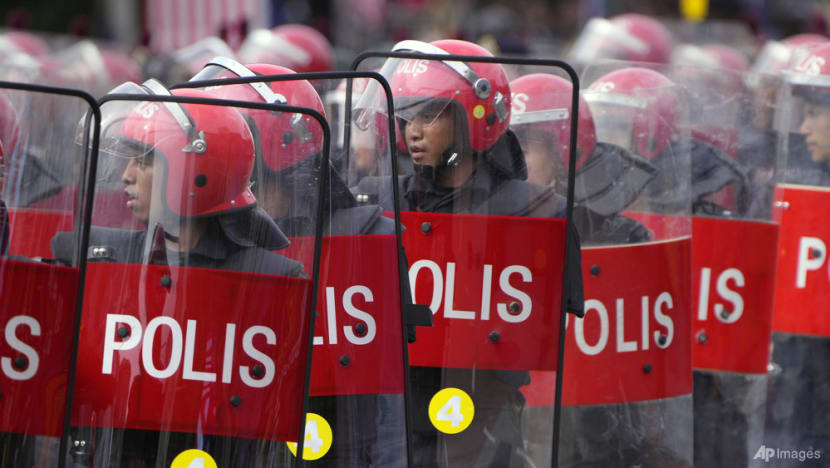
Police officers in riot gear march during the National Day parade
in Putrajaya, Malaysia on Aug 31, 2023. (Photo: AP/Vincent Thian)
Rhea Yasmine Alis Haizan
17 Jan 2024 03:58PM
(Updated: 17 Jan 2024 05:38PM)
SINGAPORE: A latest slew of
scandals involving the Malaysian police, including allegations against
one for raping a foreign student, has cast the spotlight on the
membership of an independent body tasked to probe complaints against the
men in blue, but even that has come under fire.
On Jan 10, Home Minister Saifuddin Nasution Ismail revealed the names
of five members appointed to the Independent Police Conduct Commission
(IPCC), with two spots yet to be filled.
According to Free Malaysia Today (FMT), Mr Saifuddin said that
the IPCC has the prerogative to kickstart an investigation in the public
interest without referring to any party or report.
But analysts and activists are already describing the body as “toothless”, given its limited powers.
“The IPCC has no disciplinary power over police officers who … are
found to have committed (an act of) misconduct,” International Islamic
University Malaysia (IIUM) law expert Dr Nik Ahmad Kamal Nik Mahmood
told CNA.
Dr Nik Ahmad explained that the
IPCC can only provide punishment recommendations to the police force
commission, adding that it is ultimately up to the police disciplinary
committee to determine and undertake action.
Malaysian lawyer Edmund Bon agreed that the IPCC wields very limited power.
“It is in essence more of a referral commission,” said Mr Bon, noting
that the previously proposed Independent Police Complaints and
Misconduct Commission (IPCMC) had more powers and a direct enforcement
mandate.
“The IPCMC came about after many years of consultation and problems
that we see with the police force. But the police force objected to it
(because they didn't want to be policed) and therefore you have a
watered-down version of it (through the IPCC).
“So police accountability will still be quite low because you don't
have a strong police commission or force, something like Hong Kong or
other countries,” he told CNA. - CNA, 17/1/2024
Independent Police Conduct Commission (IPCC) Act 2020 should be amended to bring about police accountability ― Hakam
Saturday, 01 Jul 2023 1:35 PM MYT
JULY 1 ― The Independent Police Conduct Commission (IPCC) comes into force on July 1, 2023. There are serious flaws in the IPCC that needs to be addressed to bring about Police Accountability in Malaysia.
Several
key provisions as stated in the Independent Police Complaints and
Misconduct Commission (IPCMC) Bill 2005 drafted by the Royal Commission
to Enhance the Operation and Management of the Royal Malaysian Police
(Royal Commission) and the IPCMC Bill 2019 have been omitted from the
IPCC Act 2020.
The
recommendations by the Parliament Select Committee on matters
pertaining to the IPCMC Bill 2019 have also not been fully incorporated
into the IPCC Act 2020.
The Independent Police Conduct Commission (IPCC) comes into force on July 1, 2023. ― Picture by Mukhriz Hazim
The key areas that need to be incorporated into the IPCC Act 2020 include inter-alia the following:
1. Reinstatement of Disciplinary Authority to IPCC
The IPCMC Bill 2005 and the IPCMC Bill 2019 vested Disciplinary Authority with the Commission.
The
IPCC Act 2020 does not have disciplinary authority and any findings of
misconduct with the relevant recommendations has to be referred to the
Police Force Commission.
It is imperative for the IPCC to be vested with disciplinary authority to ensure Police Accountability.
2. Scope of Misconduct has been restricted
The
IPCC Act 2020 states that any misconduct regulated under Section 96 and
Section 97 of the Police Act 1967 falls outside the purview of the
IPCC.
The Inspector General’s Standing Orders (IGSO’s) made
pursuant to Section 97 of the Police Act 1967 prescribes more than 100
minor and major misconducts.
There would be very little for the IPCC to investigate; as most of the misconducts would be within the purview of the IGSO’s.
Therefore,
the prohibition against investigating misconducts regulated under
Sections 96 and 97 of the Police Act should be removed for the IPCC to
ensure Police Accountability.
3. Powers of the IPCC
The IPCC Act 2020 does not incorporate search and investigation powers as provided in the IPCMC 2005 Bill.
The
search and investigation powers provided to the Enforcement Agencies
Integrity Commission (EAIC) are also not given to the IPCC under the
IPCC Act 2020.
The IPCC should be vested with the requisite search and investigation powers to function effectively.
4. Independence and supervision of IPCC
The
appointment and removal of the Commissioners should be vested in the
relevant Parliamentary Select Committee, instead of the prime minister.
The IPCC should not be under the Ministry of the Home Affairs.
5.
Issues pertaining to sensitive information and documents classified as
official secrets documents prejudicial to national security or national
interest
The classification of sensitive information
should not be in the hands of heads of department; but should be placed
in the hands of IGP or Deputy IGP.
Matters pertaining to official
secrets or prejudicial to national security should be held in-camera to
maintain confidentiality and secrecy.
Therefore, Hakam calls upon
the government to immediately amend the Independent Police Conduct
Commission Act 2020 to incorporate the aforesaid Recommendations on an
urgent and immediate basis to ensure Police Accountability in Malaysia. - Malay Mail, 1/7/2023



.jpg) The
Malaysian Bar refers to the recent announcement made by the Minister of
Home Affairs, Datuk Seri Saifuddin Nasution Ismail, where he stated
that the Independent Police Conduct Commission (“IPCC”) Act which was
passed in the Dewan Rakyat earlier this year would come into force in
June 2023.1 We are disheartened by the Government’s plan to
forge ahead with the Act, especially when the Malaysian Bar has
consistently expressed grave concerns relating to the shortcomings of
the IPCC Act.
The
Malaysian Bar refers to the recent announcement made by the Minister of
Home Affairs, Datuk Seri Saifuddin Nasution Ismail, where he stated
that the Independent Police Conduct Commission (“IPCC”) Act which was
passed in the Dewan Rakyat earlier this year would come into force in
June 2023.1 We are disheartened by the Government’s plan to
forge ahead with the Act, especially when the Malaysian Bar has
consistently expressed grave concerns relating to the shortcomings of
the IPCC Act.